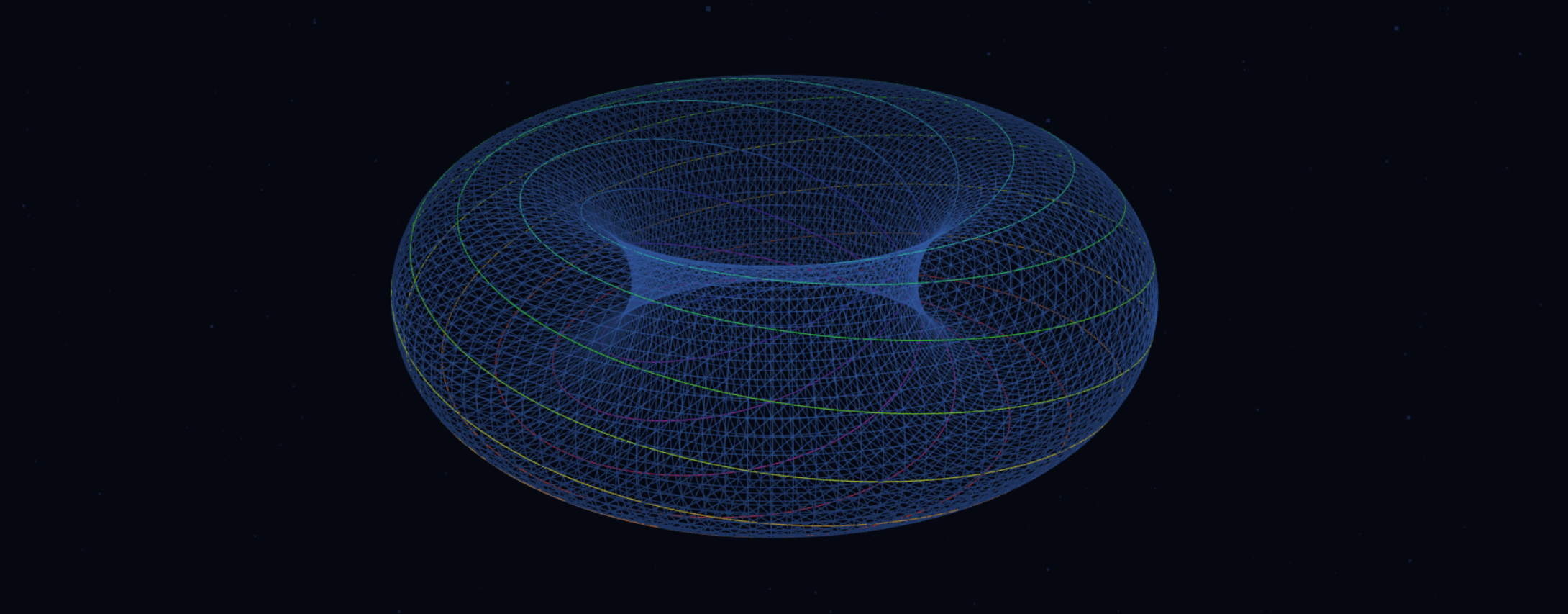
I see electrons as EM wave packets in a toroidal shape.
The toroidal shape is based on two circles and I think the winding on the smaller circle is what gives it structural stability. And this winding might explain the apparent outer charge of the electron, and the difference between electrons and positions: positrons have a reverse winding orientation. The small circle winding is a large topological difference that might explain their stability and why electrons and positions cannot just be converted into each other, and why a collision of both causes annihilation.
While looking for possible descriptions of such a torus I stumbled upon Hopf fibrations. These seem to be a good match, and in fact there are claims that such a structure could be a topology for magnetic monopoles or explain ball lightning effects. That’s quite literally what I imagine the electron to be like, a shape of pure energy.
So, what is the difference between photons and electrons and what do they have in common? It seems that photons are helical structures with their rotation defining the circular polarization. Apparently electrons can absorb and emit photons up to the point of total annihilation and creation of electrons purely from photons. It seems electrons “are made of photons”, but with an extra structural grain of salt.
Observation: A high energy photon with the energy content of two electrons (plus a bit) can be turned into an electron and a positron when it enters the strong field of a nucleus. This is called pair production. When an electron and a positron approach, they attract each other and annihilate into a high energy photon.
Speculation: The strong field of the nucleus can somehow bend or reshape the photon energy into a stable torus, bending the photon into two closed rings, creating the electron and position.
I considered the electron to fill the whole orbit at once, being a standing wave going all around the orbit. But this concept was ignoring the “size of a photon”: The energy content of a photon is relative to its wavelength, and (somewhat uncomfortably) to its wavelength only. There is no length or count of wavelengths and no amplitude that matters. And assuming that the same is true for the Compton wavelength, the “size” of the electron must be similar to a photon with the same (Compton) wavelength. For the electron wave to go all around the first Bohr orbit (the first orbit in the hydrogen atom), we would need 137 (1/\alpha) wavelengths, but that would mean (Planck says so) there was 137 times the energy. Or, we need a longer wavelength (matching the de Broglie wavelength), losing all but 1/137 of the energy. So…. I could not find a solution for this.
Then I stumbled upon a paper from John G. Williamson and M.B. van der Mark from 1997, ”Is the electron a photon with toroidal topology?”.
Here is a very nice video from Huygens Optins covering the key ideas of the paper plus some background (“A Electrons made of Light?”):
https://www.youtube.com/watch?v=hYyrgDEJLOA
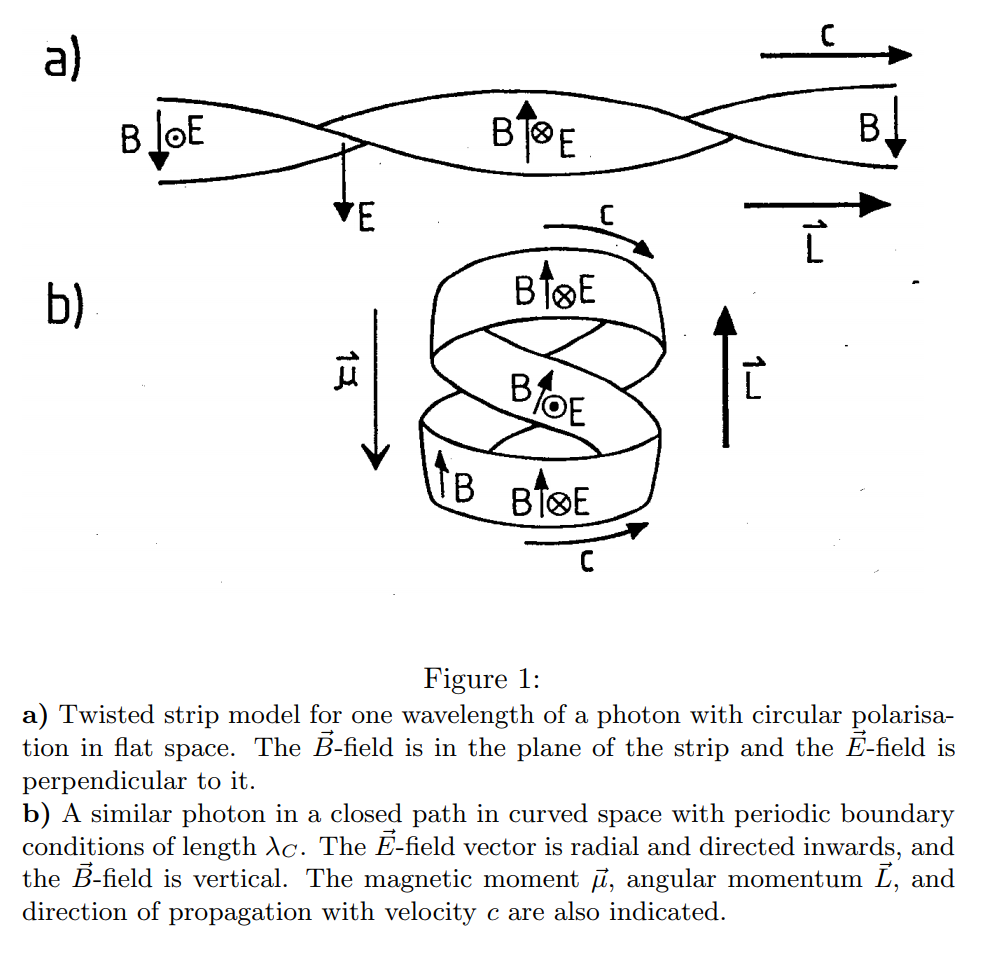
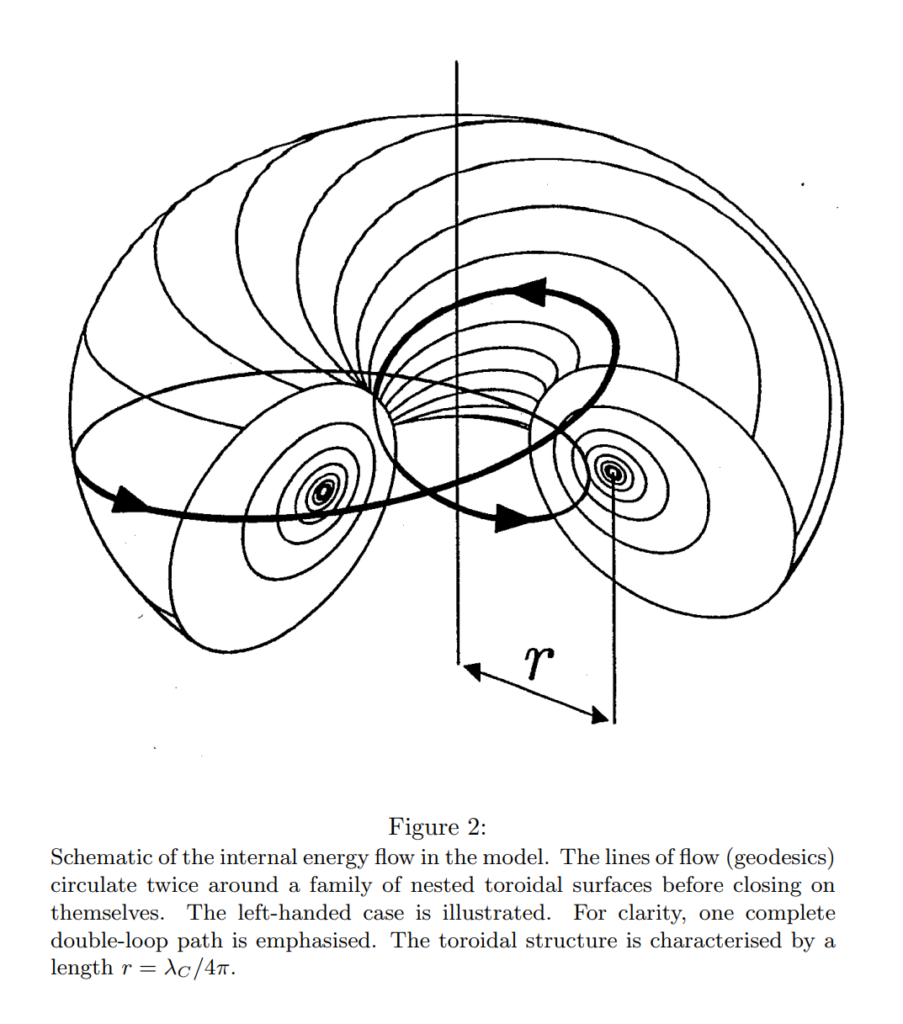
The WvdM concept also sees the electron as a torus, but with only ONE wavelength of the photon, and this wavelength is folded twice into a tiny circular structure. It’s one and only one wavelength for the electron. (Which btw. must be true for photons, as well).
Here some original images from the paper:
This is a very interesting idea with some compelling properties:
- The electron is „made of light“, it is a photon-like EM wave twisted into a toroidal structure. One wavelength goes around the torus twice (winding number ½) in a helical pattern that closes on itself. (The winding number defines small-circle rotations per big-circle rotation. So, the wave has to go around the big circle twice to meet its own small circle rotation.)
- The size of this torus is about r = λC/4π (the Compton wavelength of the electron wound around a circle twice).
- This complex shape will ensure that negative field lines of the waves are all always pointing outwards, creating the apparent charge of the electron.
- Or pointing outwards in case of the positron that simply has a different handedness of the rotation going around the torus.
- The rotation around the big circle can explain particle spin.
- For the wave to complete a full cycle, it has to go around 720°, which can explain the ½ spin property of the electron,
- Some of the total electron energy “leaks” out into the static electric field. Seen from a distance, this is indistinguishable from the appearance of charge.
- The charge of this object can be estimated and the result is remarkably close to the actual electron charge.
- „The external field is non-rotational and will slightly reduce the energy and hence shift the wavelength and frequency of the spinning photon inside the boundary“
- “This correction is small and is of the order of α/2π where α ≈1/137 is the fine-structure constant.”
There is a challenge, though: A mechanism for confinement is not clearly found. If this is just an EM wave, why does it not disperse? It might be magnetical or based on non-linear effects of the EM field. (Idea: the reason could be purely topological. More below.)
Pair production symmetry
This concept has some very interesting consequences, and it can nicely explain many observations. The torus can be seen as a combination of two rotations, a big one around the center (the hole of the donut), and a small one around the tube. The rotation around the big radius is equivalent to particle spin. The rotation around the small radius defines whether negative or positive field lines will be pointing outward, thus creating either an electron or a positron. They have a different chirality for the small rotation.
What happens in pair production of electrons and positrons can be literally seen as the conversion of a photon into particles. Why two particles? The angular momentum in the twist of the torus and because of the opposite charges that cancel out each other. The photon was electrically neutral, so has to be the net result of the conversion.
de Broglie
The WvdM paper also gives a nice explanation of the de Broglie wavelength as being created by the doppler shift of the internal circulation. Parts of the circulation wave will experience a red shift, other parts a blue shift. This will create a “beat pattern” that changes with velocity. The de Broglie wavelength is infinite or non-definable at rest, and it contracts with rising velocity, and this beat pattern would behave similarly.
Charge
The paper makes an estimation of the apparent charge that such a contained wave produces. This calculation is based on the simplified assumption that the total field energy is contained within a sphere. They then compare the field energy of a point on that surface to the field a test charge would see from a point charge in the center of that sphere. The result is very close to the actual charge of the electron with an error of about only 9%. I find this is remarkably close, this could have been off by several magnitudes, but a result so close confirms that this is a plausible concept. The remaining error can well be attributed to the simplifications they used.
One aspect I find particularly remarkable: This final calculation does not involve the energy or mass of the electron! The apparent charge is purely the result of the topology (and the Planck constant). Any self-confined wave structure with only one side of the EM field lines “leaking out” would appear as the same charge.
There is another recent paper from The dos Santos & Fleury (2025), “Toroidal Electron Model”, that has a quite similar idea and that follows a more mathematical approach (“Ansatz”). They use a lot of parameter fitting to get the right results, but in the end this is confirming the principal idea works. They waere apparently unaware of the WdvM paper. There is an interesting quote:
“We invite the reader to reverse the conventional reading of ∇·E = ρ/ε₀, interpreting it from left to right: fields generate charge.”
(ρ = charge density)
Challenge: How can the electron torus be affected by a static electric field?
Speculation: The electron creates a gradient pointing. The electron wave is slightly pushed along this gradient, giving momentum to the whole electron torus. The energy of the electron is resisting this push, explaining the inertia of this structure. What we perceive as mass is actually just the tendency to resist this change, the higher the energy content, the higher the inertia.
The WdvM electron model and Bohr orbits
Summary:
The de Broglie wavelength of the electron is created by the doppler shift of its internal circulation. The orbit of the electron has to match its de Broglie wavelength, because the electric field that the electron encounters has to match its journey around the orbit. A “harmonic resonance” has to be found. The electron creates a push on the field, but the field also pushes back on the electron. When the de Broglie wavelength matches the orbital, a stable pattern can emerge, the internal rotation can fit into the exact same external field it created on its previous rotations. At any other orbit or velocity, the electron had to constantly fight against the electric field it created itself during the previous orbits, which would radiate energy.
This is exactly the classical problem that Bohr was trying to solve when he originally defined this condition for the Bohr orbitals. At the quantized orbit, the electron encounters its own field in phase. No net work is done against the field. The electron can continue indefinitely without radiating.
So…. that was an idea, but it turns out it’s not that easy. The electron has a speed of “only”
c/137 and field changes should propagate with c, so, long before it can reach “its own field” from the previous passage, it has long been “blown away” by the field from the nucleus. I’m still not sure that this won’t create a resonance pattern nonetheless, but this effect must be much smaller than I thought.
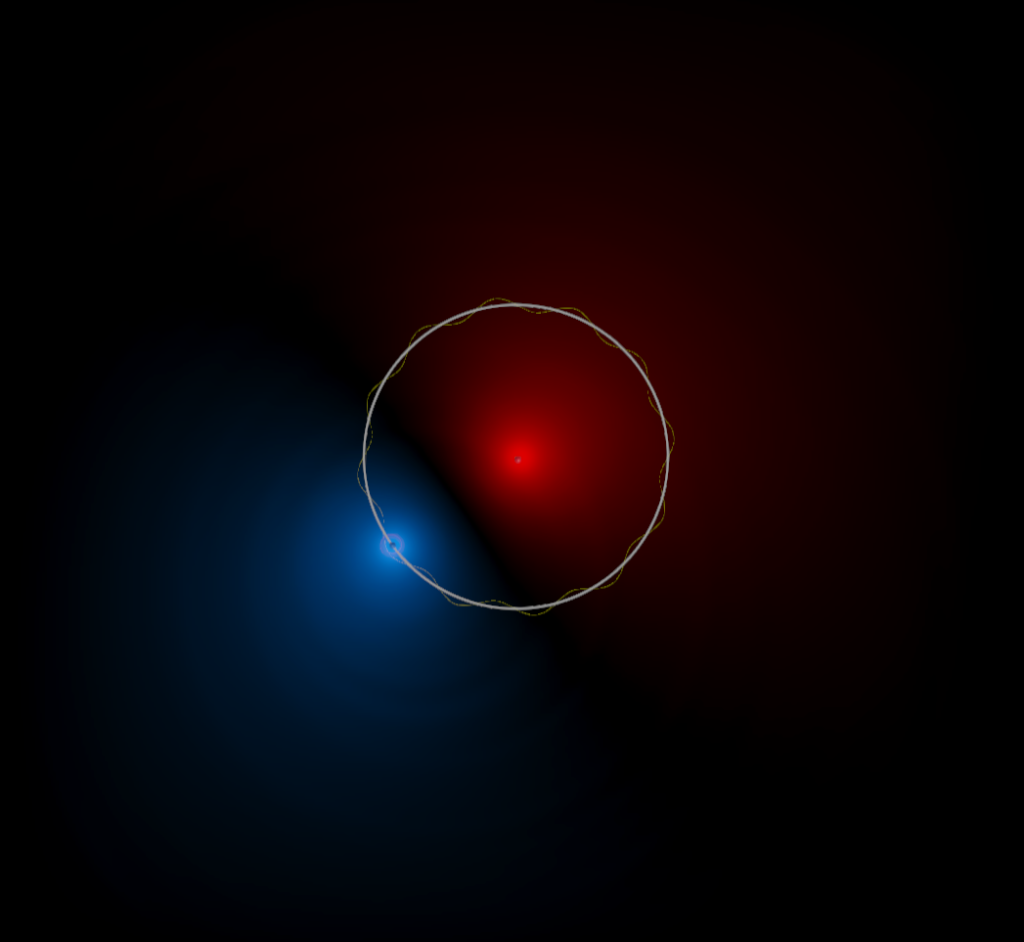
[Image of an electron circling a nucleus, with the electric fields around electron and nucleus, created with a simplified cellular field simulation. The positive and negative fields neutralize each other between them and for the outer regions. There is no negative electron field remaining on the far side of the orbit, only the positive near-field from the nucleus. Without the previous passage of the electron, this field would still be very different and much stronger. I’m not sure that’s enough to create a resonance-condition.]
But here is another approach: The red-blue shift from the Doppler effect, which is responsible for the de Broglie wavelength, would probably create a slight imbalance in the electrical field of the electron. One side would be slightly more negative than the other. The frequency of this shift matches de Broglie wavelength. When the orbital circumference matches this wavelength, the red-blue-shift can get into a co-rotation with the electron orbiting the nucleus. The slightly more negative side will be attracted to the nucleus, and when in corotation, it can remain that way. Plus the more positive side of the electron will face outwards from the nucleus, further reducing the rotating dipole effect.
Two electrons in one orbit (a probably obsolete speculation)
Two electrons in the same orbital must have complementary spins. Because the spin axis can be parallel or antiparallel to the orbital axis, one of them will have a slightly stronger energy level than the other, because the doppler effect creating the de Broglie wave will be slightly stronger. This will lead to two slightly different orbits that are very close to each other.
Because of the stability condition that the e field created in the previous passage has the match current phase, two electrons in the exactly same orbit would interfere. The slight difference in orbital size allows these two “wakes” to coexist. But they will influence each other, the outer one pushing inwards, the inner one pushing outwards. This push and the resonance will also ensure that both electrons will be at opposite ends of the orbit.
The two electrons won’t be differentiable during excitation or ionization. The symmetrical counter push of both electrons will even out, so no matter which electron is “hit”, the required energy will be the same.
Sidemark: When one of the electrons is pushed into a higher orbit,the remaining electron will lose the immediate push of its partner and therefore change its orbit, probably to a quite smaller one. When the excited electron comes back, both have to settle into a stable partner-configuration again. So, even a single electron-level jump includes a quite complex interaction. Which might be reflected in whatever radiation is created.
Why 137 wavelengths?
The Fine Structure Constant
α = e²/(4πε₀ℏc) ≈ 1/137
This dimensionless number characterizes electromagnetic interaction strength, it describes the ratio between the electric repulsion of two electrons and the energy required to overcome it. It’s a ratio that describes how much the energy of an electron is in the static electric field it creates (extending to infinity) vs. the energy contained in itself (in its mass).
It also describes the ratio between the electron’s Compton wavelength and the size of the first Bohr orbit.
Why is 1/137 the same factor between for the electric coupling and for the ratio between de Broglie and Compton wavelength in the first Bohr orbit?
- In the Bohr orbit, there are two forces that have to match, the Coulomb attraction between electron and the nucleus, and the centripetal force of the electron in its orbit.
- For stability reasons (see above) the orbit has to match the De Broglie wavelength, which is also dependent on the momentum of the electron.
- It turns out that a perfect match is found at v = c * ɑ.
So the same factor that defines the electric coupling also defines the ratio between de Broglie and Compton wavelength for the first Bohr orbit. It’s not a coincidence.
1/137: Leakage vs. Coupling
Why is the ratio of the energy “leaking” into the field to the energy contained identical to the coupling strength, the strength that a given e field pushes the electron?
It has to be for symmetry reasons. In its journey around the electron torus, the wave will create an outgoing (outwards pointing) electrical field. This field itself will push back on the internal wave. The outer fields get stronger until an equilibrium is reached. If another electron is affected by this field, it will react. This reaction has to be precisely the same as this own internal push, otherwise the two electrons would affect each other in a non-symmetrical way.
Why ~1/137?
This is THE fundamental question (and the answer is not 42, unfortunately). Physicists are looking for an explanation, unsuccessfully so far.
The calculation (α = e²/(4πε₀ℏc)) involves some measured constances, the fundamental charge and the Planck constant h (or h_bar = h/2pi), which define the relation between frequency (rotation) and energy in a photon. And finally ε₀, describing the permittivity of the electric field. How these relate to each other, defines α. Or put differently, α defines how these relate to each other. When using Natural Units, h_bar and ε₀ can be replaced with “1”, the value we usually see for them is just a conversion into our arbitrary human units. The remaining one, the “fundamental” charge e, still has to be measured.
Since α is a unitless constant, I strongly believe there must be a geometrical reason.
The dS&F paper uses α to calculate their minor torus radius: r₀ ≈ √(πα) rc.
That’s an interesting idea. But they also make the other parameters fit until the proper value for e (the electron charge) emerges. They acknowledge this with a von Neumann quote:
“With four parameters I can fit an elephant, and with five I can make him wiggle his trunk.”
So this puzzle is still missing some pieces.
Challenge: How can waves collide as particles?
This sounds like a contraction at first. Usually, when two waves overlap in different directions, they pass through each other and come out unaffected. But the EM field is not just like a water surface. The magnetic field gives it curvature that affects how energy is transferred. And there is an…
Observation: CERN experiments show high energy photon-photon scattering results. Yes, photons can be directly affected by other photons when high enough energy densities are involved.
QED Corrections as Geometric Perturbations
Classically seen as a “solid particle”, the magnetic moment of the electron, g, should be precisely “2”, but it’s not, it’s g = 2.002319…
This value can be measured with extreme precision. So, why this deviation?
The Wobbling Torus
The electron isn’t rigid—it’s elastic. When perturbed:
1. Internal wave pattern gets “kicked”
1. Structure wobbles, sloshes
1. Eventually settles back to equilibrium
The α/(2π) correction to magnetic moment:
– α appears: the torus sees its own electrical field.
– 2π appears: one full loop of self-interaction
Higher-order corrections (α², α³…): multiple ripples, more complex wobble modes.
This seems to be a good derivation of g = 2.002319 from geometric effects.
Open Questions
Confinement is the most puzzling question. Currently I’m leaning towards the direction that the topology itself creates stability. In fact there are other experiments that claim to have “tied light into knots”:
https://www.sciencealert.com/laser-light-knots-polarisation-singularities-seifert-surfaces.
This seems at least to prove that the field of light can create influences on itself, which I think would not be possible in a pure (harmonic oscillating) wave medium. Summary from Claude:
How the Light Knots Work
The experimental setup uses holographic beam shaping to create carefully designed superpositions. From the Nature Physics paper, the apparatus works by taking linearly polarized laser light, splitting it into horizontal and vertical polarization components, and using spatial light modulators to imprint specific phase patterns onto each component. When these components are recombined, the interference creates the knotted polarization singularity structure.
The resulting structure propagates with the beam—it’s not a fixed, stationary object in space. The knot exists as a three-dimensional pattern that extends along the propagation direction. As the beam propagates, the knot moves with it.
You’re also right that the continuous beam maintains the structure. This is fundamentally different from a self-sustaining soliton. It’s more like a standing wave pattern that exists because energy is continuously being fed in. Turn off the laser, and the knot vanishes. The topology is “imposed” by the beam design rather than being self-maintaining.
(Summary from Claude Opus of the paper in respect to this theory.)
This is quite different from what we need for the electron. We will still need some form of non-linearity, not only to explain the non-dispersion, but also to explain the exact energy levels that electrons (and other particles) apparently require. If the confinement would be purely topological or e.g. magnetic, any size/volume/energy level should be possible.
Update: see Q = φ + A – The Nature of the EM field for a possible explanation about confinement.