Photons vs. Radio Waves
What if radio waves and photons are not one and the same? Radio waves are considered to be a collection of lots of photons, but maybe they are inherently different.
Observation: EM field effects can exhibit different properties. Radio waves are large scale effects created by moving charges in an antenna, whereas photons are created by electrons jumping to a lower energy level. Photons are a much much smaller effect. Photons and radio waves propagate differently, radio waves spread out, they dissipate, while photons remain bundled and travel on a straight line, as a ray.
Speculation: I think that photons and radio waves are not the same. They are created differently, so I think that radio waves are really just plain EM field excitations, but that photons are self confined wave bundles with a certain topology. Radio waves are not made of (virtual) photons. There is an overlap where bundles of photons behave coherently as a wave. And singular photons also still have wave-like properties. They can be seen as wavelets or solitons.
Speculation: The Helical Photon
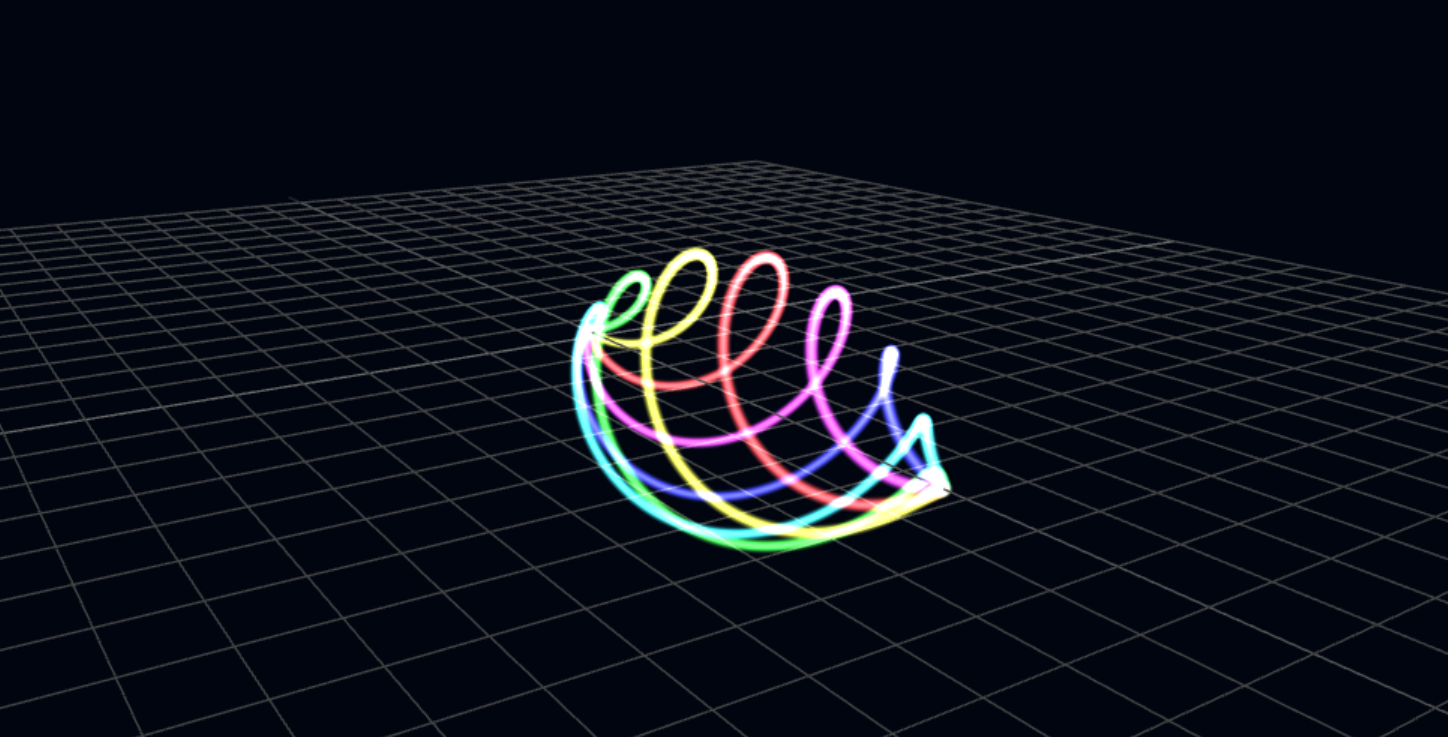
The photon could be a helical EM wave pulse with the electric and magnetic fields winding around the axis of propagation. This could produce a self confined solution wave the the energy is curled back by the magnetic field to direction of propagation, like a corkscrew winding through space.
Planck says, there is a fixed ratio between the frequency of a photon and the energy content, or seen differently, between the rotational speed and the energy content. This rotational speed IS curvature.
But why is the Photon a single quant of energy, not a dispersing EM wave?
The Planck constant is often described as “quantum of work”, but that’s not correct, instead the value describes a linear relation between frequency (rotation) and work. The curvature itself is also not discrete, it cannot be, otherwise fields could not extend out smoothly. (There might be a quantization of space and time aka. Planck length and Planck time, but compared to photons, electrons, protons and neutrons, these are several magnitudes smaller.)
I think that this quantization emerges from topology: A photon is exactly ONE TWIST of the EM field, not more, not less. Radio waves (which I consider to be different from photons) do not undergo this constraint, their curvature can be much smaller than a whole twist. Being one complete twist is why photons can’t be divided and I believe this is also the reason why they do not disperse.
There is no exclusion from being a double-twist or more: I think that’s totally possible and that’s probably what laser light is. Laserlight could consist of photons that are not just coherent but which have more than one consecutive twist. A single twist is just the smallest possible unit.
Another aspect of the EM field is what could be described as tension. Classically, we see the field generated by a charge as a purely outgoing phenomenon. But that’s not completely true, the vacuum impedance of the EM field (surprisingly simple described as just 377 Ohm) can be seen as its “stiffness”, its resistance to change, but it also creates a kind of tension, giving feedback to the source of change. This tension is proportional to the local strength of curvature.
Here I want to clarify something: there can be arbitrary strong fields without curvature. A static electric field, no matter how strong, just sits there, it points outward from a charge like spokes on a wheel. A static magnetic field in an MRI is similar, immensely powerful, but largely uniform, not twisting or propagating.
But when E and B are dancing together, each one’s change is driving the other, that’s when you get propagation. That’s when you get curvature in the sense I mean: the field is winding through space, not just filling it. And the tighter that winding, the higher the frequency, the more energy packed into each twist.
The Photon as a Single Twist
The mental image of tension in an otherwise uniform field helps me to visualize how a single twist can propagate, and how twists create tension. And why the topology of a single twist could be enough to explain confinement of the photon, why it does not disperse: The field is constantly working to reduce tension. When a photon travels through the field, the field has to be smooth again after it passes through. An incomplete twist would leave some tension behind. A small twist (i.e. < 180°) could just flatten out (and disperse as radio waves), but for a larger twist (> 180°) it’s easier to complete the full rotation to create a smooth, “flat” field behind it.
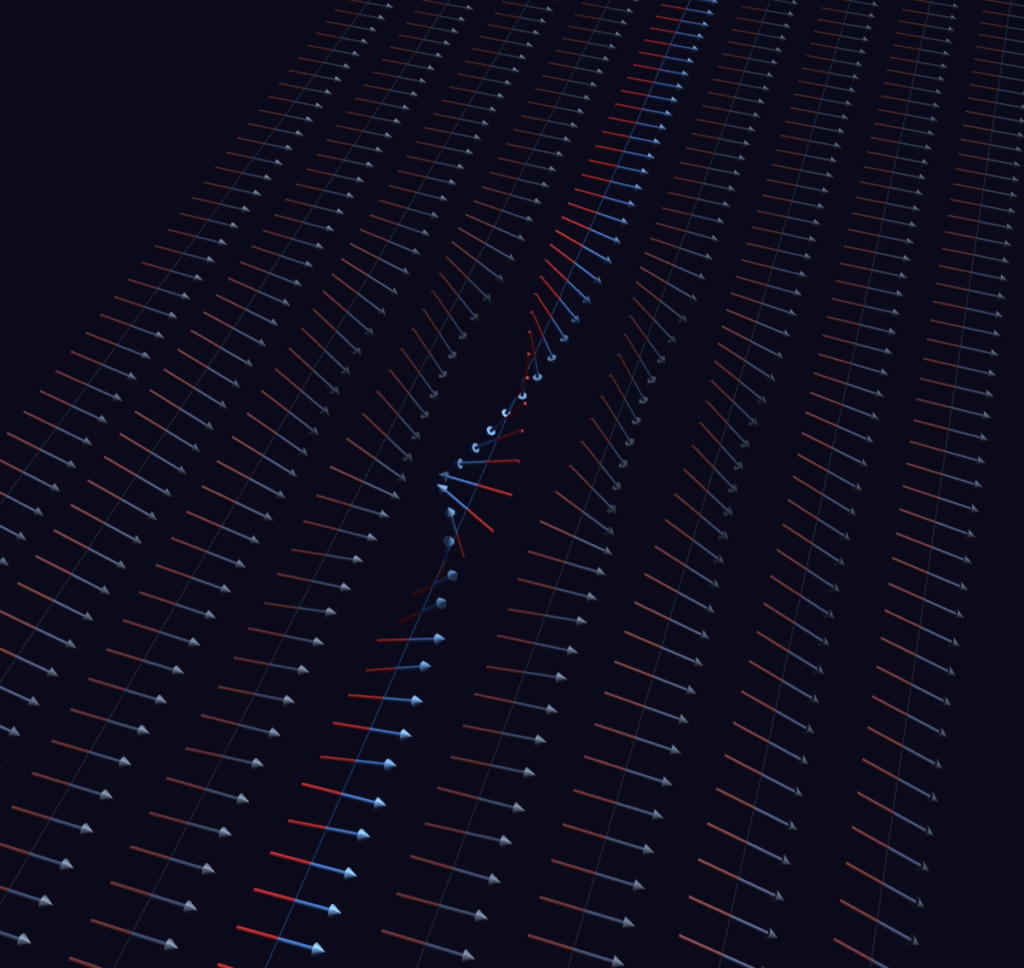
[Figure: A vector field consisting of arrows. The arrows are lined up in parallel ribbons. The center ribbon shows a full twist (arrows going around 360°), slightly affecting the neighbors, with a flat field before and behind the twist.]
But what is the size of a photon?
The above image nicely shows a single twist in a ribbon, with the neighboring ribbons only slightly affected. That’s probably a bit too simplistic. A photon has a dimension, it can’t be point-like (or line-like) because it refracts, it bends around corners according to its wavelength. So it must have length and width. Considering the idea that this is a twist in the EM field, its length and width must be closely related, because otherwise this would require an asymmetry in the curvature of the field. A twist along a thin line would require a very tight winding along the propagation axis. If the photon was a long, thin structure, this would imply a kind of asymmetric curvature, the helical structure had to be squeezed into a very narrow curve along a long line of propagation. That feels wrong, this would require a preferred axis along the propagation. So, the width of this curve has to be (more or less) identical to the longitudinal size of the twist! This implies that photons must be kind of spherical, shaped like a ball, but with a smooth start and end.
Maybe somewhat like this:
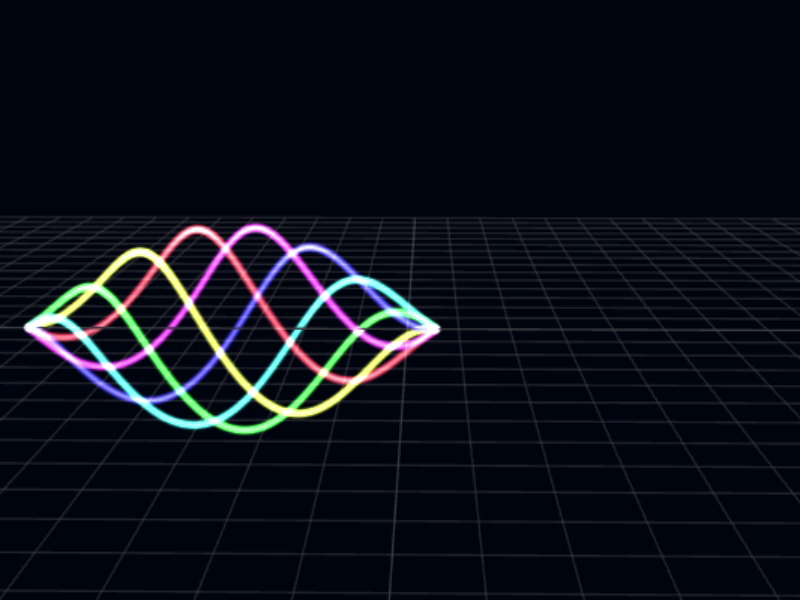
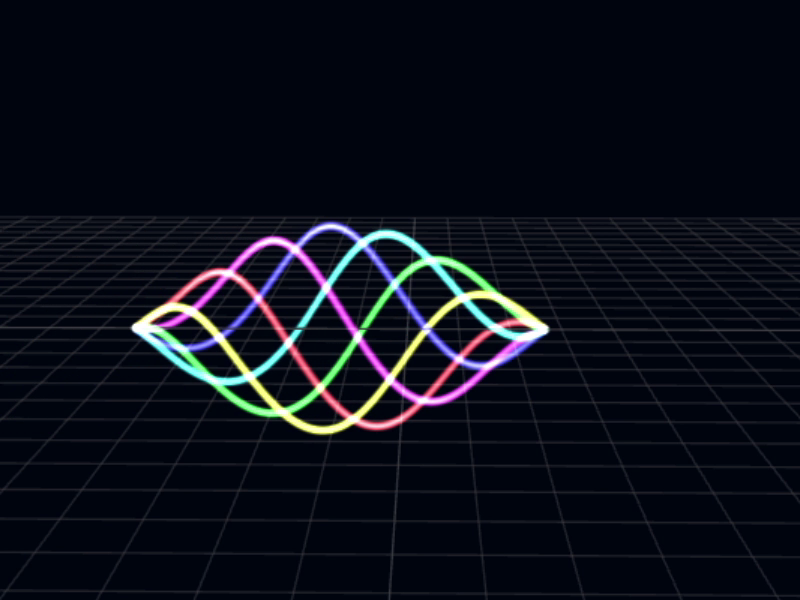
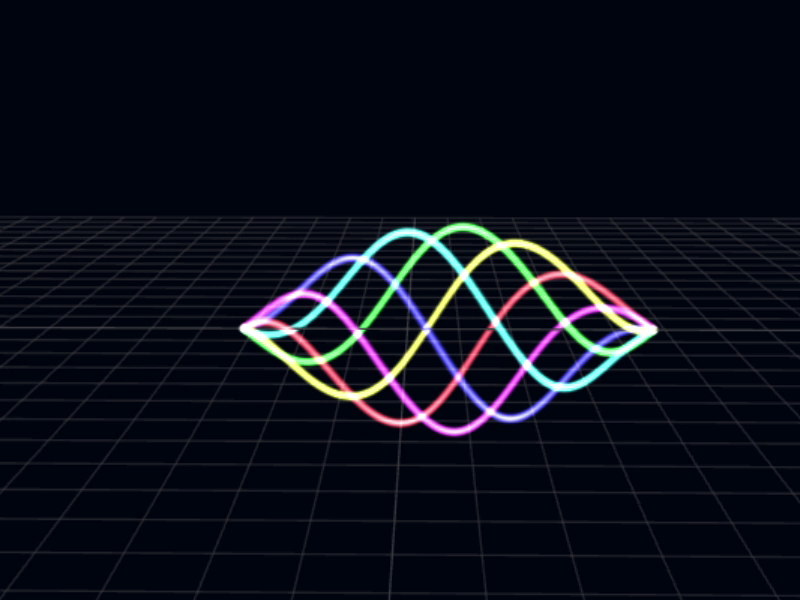
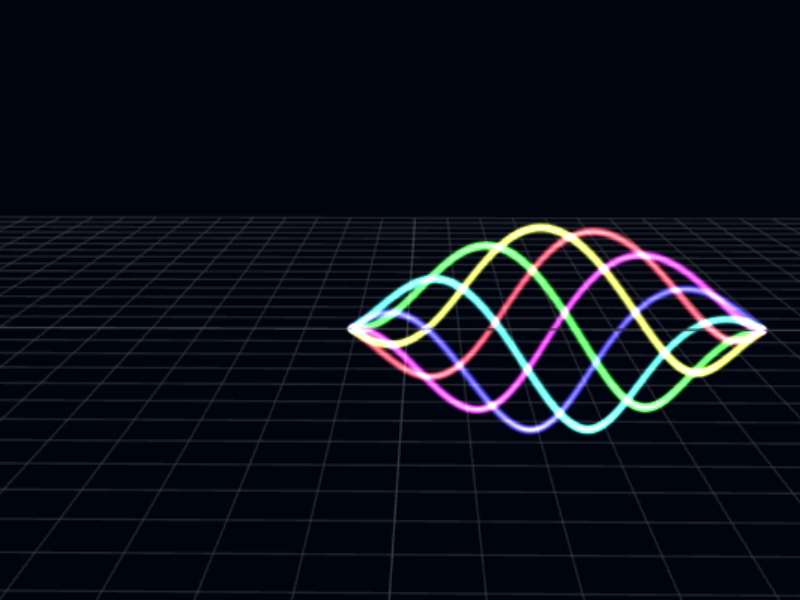
[A sequence of images showing an object consisting of helical strands going around a central axis. Each strand performs a single 360° rotation, starting at the central axis, going outward and coming back to the center. Several strands together form a spindle-like shape. While the object propagates to the right like a spinning bullet, each strand looks like a standing wave with only the amplitude coming and going.]
Please note that this is a 3 dimensional object, not just some flat curves.
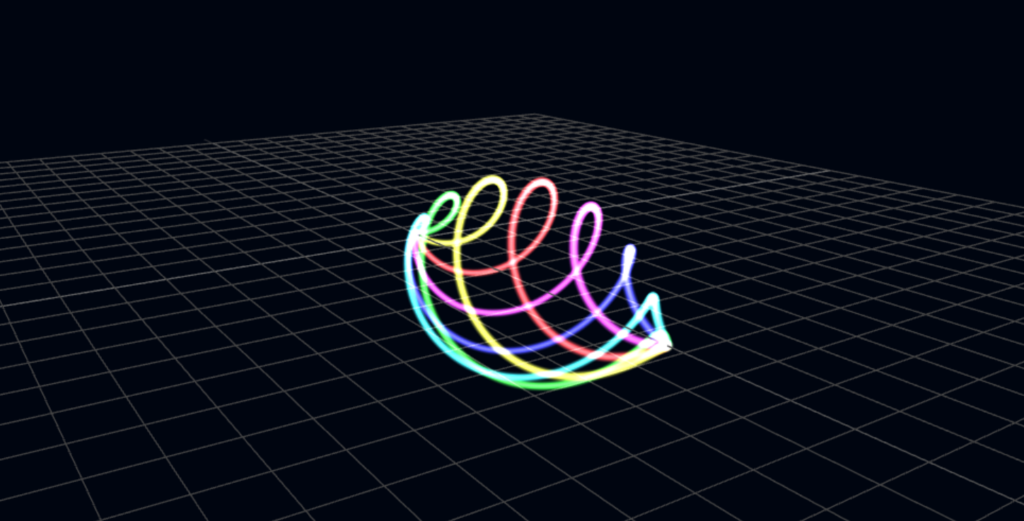
The images are screenshots from this interactive visualization:
This shows how I imagine the photon: A single twist in the field, like a vortex of energy moving forward. The dimension of this object does NOT show the field intensity as often seen in photon depictions, no, I think this is the actual spatial extension of the photon.
The photon propagates like a spinning bullet, with the entire structure rotating around the axis of travel as it moves forward. Each strand remains in place like a standing wave, with only the amplitude rising and falling as the photon passes through that region of space.
The distribution of field energy is a different aspect not explicitly shown here. But I do assume the field to be the strongest on the outside and weaker on the inside. Also quite opposite to the usual description of photons. My reasoning for this: curvature. Imagine the inside of this shape to be filled with similar strands, but with weaker amplitudes. Weaker amplitudes mean less curvature, less energy content. The outside of the shape has the strongest curvature, caused by the highest energy density.
Initially, I built this visualization with only one strand spiraling around, but that felt very incomplete for my intuition. I added more strands to turn this into a full volumetric object. I now see the strands as only a way to depict the outer perimeter of the photon. In the interactive visualization, you can change the number of strands to see a single strand or to create a more solid object with many strands. The whole photon is a circular vortex, like a vortex ring in water, where all of that moving water is the vortex. Each strand can be seen as having outward pointing E and B field components while rotating around the core. But the photon is not just one of these strands, it’s all of them filling the spindle-shaped volume.
This shape also can nicely explain why a photon has the size it has, and why its energy content is directly related to its wavelength, and and not to size or amplitude: If this object would have a different energy density, the curvature would have to be different as well. Energy density IS curvature. More energy density creates a tighter curvature, making the whole object smaller. Less energy contained will create a weaker curvature, making the object bigger.
This is why E = ℎ * f !
The energy content of a photon is directly proportional to its size, because the structure of the EM field itself creates this self-consistency.
Polarization
The polarization of this photon is identical to the classical interpretation. Circular polarization is directly defined by the direction of rotation of these strands around the core. I’m not sure about linear polarization, yet. This is an open question. But I find the classical description that linear polarization is caused by two overlaid conter-rotating polarizations not very convincing, either. This is a mathematical construct, but not an explanation how this can be an actually stable field configuration.
Size and energy content
The size of this photon object would be about 1 wavelength in diameter and mostly spherical, probably a bit elongated like a football with smooth field gradients at both ends, to create a smooth and consistent curvature of the strands. The energy content of this shape does match the Compton wavelength of this energy content, but, of course it does, because the Compton wavelength is exactly defined to match the energy content of a photon, so, duh.
There is another consistency check from Claude below. This has to be checked for validity! But I think it’s plausible. And in the result this would mean:
When you put quantum energy into a classical EM field configuration of size λ, the resulting field curvature naturally matches what’s needed for a single twist structure. Or the other way around,
If a photon is a single-twist soliton of size λ, then:
- The field curvature required for that geometry
- Produces exactly the energy E = ℎf
- Using only classical EM parameters (ε₀, c)
This suggests ℎ might be geometric rather than a separate quantum constant. And, in fact this is consistent with Planck’s natural units. In natural units, ℎ = 2 π. So, the Planck constant literally describes what’s required to perform a full 360° rotation in the EM field. A slow (and big) turn requires little energy, a fast (and tight) turn encounters more “stiffness” of the field and requires more energy.
Confinement
This is the critical question: Why would a photon of this shape not disperse into a classical radio wave? I’m not 100% sure. Non-linear effects of the EM field such as the Schwinger limit are not applicable here because the field strength of photons (i.e. such as low-infrared photons) is by far not high enough. My speculation is that it is the topology itself that provides confinement. The structure of the full twist redirects the energy back to the center. And the concentration of the energy in the outer perimeter of the photon might create a form of self-influence which leads to non-linearity. But this is not proven or simulated, yet.
Conceptual Summary
| Standard View | Geometric Field View |
|---|---|
| Photons are quanta of light | Photons are single-twist vortex structures in the EM field |
| Photon size is undefined/point-like | Photons have spatial extent ~λ (spindle-shaped, ~spherical) |
| Radio waves are collections of photons | Radio waves and photons are fundamentally different EM phenomena |
| Energy and wavelength relation is postulated | E = hf emerges from field curvature geometry |
| Planck constant h is input/axiom | h may emerge from topology: one twist = 2π rotation |
| Constants are unexplained inputs | Constants may be geometric/emergent from field structure |
| Quantization is fundamental axiom | Quantization may emerge from topological constraints |